
Accurately calculate bacteriostatic water volume and precise syringe dosage in clicks.
PEPTIDESUP TOOL
Peptide Solution Calculator
Calculate solution concentration and the theoretical volume corresponding to an amount entered by the user.
Illustrative scale only.
How the calculation works
Concentration: peptide amount (mg) × 1,000 ÷ final solution volume (mL) = mcg/mL.
Volume: entered amount (mcg) ÷ concentration (mcg/mL) = mL.
Syringe scale units: calculated volume (mL) × syringe calibration (units/mL) = theoretical scale units.
Frequently Asked Questions (FAQ)
A peptide reconstitution calculator is a tool that helps determine the concentration of a peptide solution after reconstitution. By entering the peptide amount in milligrams (mg) and the final solution volume in milliliters (ml), you can calculate the resulting concentration in micrograms per milliliter (mcg/ml).
To calculate peptide concentration, convert the peptide amount from milligrams to micrograms and divide it by the final solution volume.
Formula:
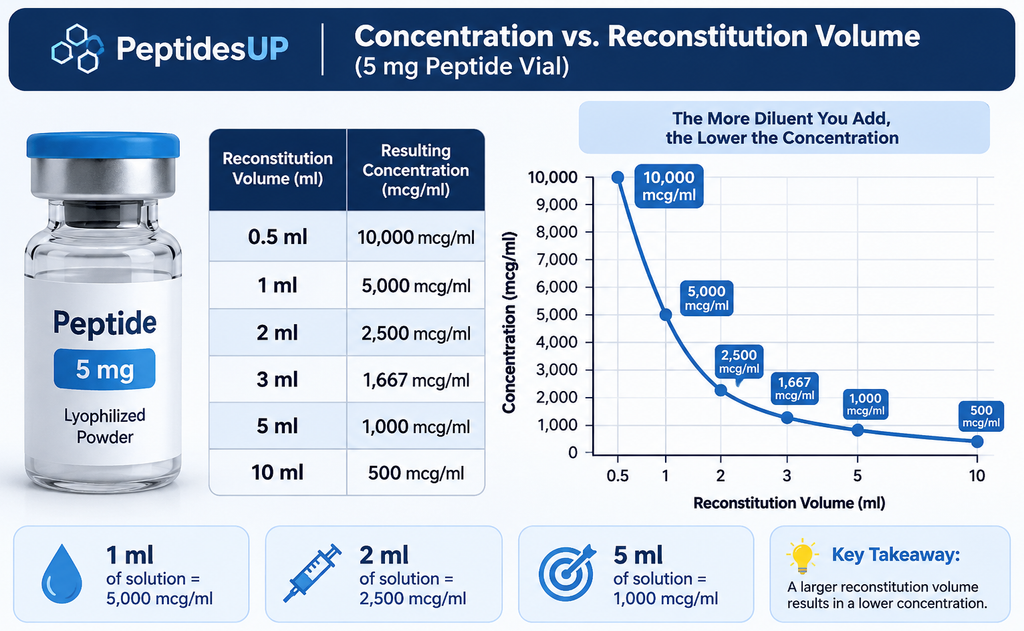
Peptide concentration (mcg/ml) = Peptide amount (mg) × 1,000 ÷ Final volume (ml)
For example, 5 mg of peptide in a final solution volume of 2 ml gives a theoretical concentration of 2,500 mcg/ml.
First, calculate the volume of solution required for the specified amount in micrograms. Then convert that volume into syringe units according to the syringe calibration.
For a U-100 insulin syringe, 1 ml corresponds to 100 units. For a U-40 syringe, 1 ml corresponds to 40 units.
The calculator performs this mathematical conversion based on the selected syringe type.
U-100 and U-40 syringes have different calibrations:
U-100: 100 units per milliliter (1 unit = 0.01 ml).
U-40: 40 units per milliliter (1 unit = 0.025 ml).
The same liquid volume corresponds to different unit markings on these syringes. Always verify the syringe type before interpreting a calculated result.
The appropriate reconstitution volume depends on the specific product, its formulation, and the manufacturer’s instructions. There is no universal volume that applies to all peptides.
This calculator does not recommend or determine how much bacteriostatic water to use. Enter the verified final solution volume specified by the product instructions or a qualified healthcare professional.
Yes. You can select different syringe capacities, including 0.3 ml, 0.5 ml, and 1 ml. The calculator uses the selected capacity to help identify whether the calculated volume fits within the syringe.
However, syringe capacity and syringe calibration are different characteristics. Always check the actual markings and specifications of your syringe.
The calculator performs general mathematical conversions using the values you enter. It does not verify whether a particular peptide can be reconstituted with a specific solvent or whether a calculated concentration is appropriate for that product.
Always follow the manufacturer’s instructions for the specific peptide, including solvent compatibility, storage conditions, and handling requirements.
No. This calculator is an educational tool designed to perform mathematical conversions involving peptide concentration, solution volume, and syringe units. It does not provide medical advice, recommend treatment, or determine safe or appropriate doses.
Consult a qualified healthcare professional before preparing or using any injectable product.
The calculated concentration depends directly on the final solution volume. For example, the same amount of peptide will produce different concentrations depending on the final volume.
The volume of solvent added is not necessarily identical to the final solution volume. For accurate calculations, use a verified final volume rather than assuming both values are interchangeable.
Syringe graduation refers to the smallest marked increment on the syringe scale. It determines how precisely a volume can be measured using that particular syringe.
A calculated volume may fall between the available markings. In that situation, the calculator can display a warning rather than suggesting an inaccurate rounded measurement. Always use a syringe with suitable markings and follow professional instructions.