
Peptides and proteins play a central role in the biochemical and physiological processes of living organisms. Although these terms are sometimes used interchangeably, there are important differences between them related to size, structure, and biological functions. This article examines key aspects that help clarify whether peptides and proteins are the same thing or not, as well as the differences between them.
Table of Contents
- What are peptides?
- What are proteins?
- Amino Acids as the Building Blocks of Peptides and Proteins
- Key Differences Between Peptides and Proteins
- The Practical Significance of These Differences
What are peptides?
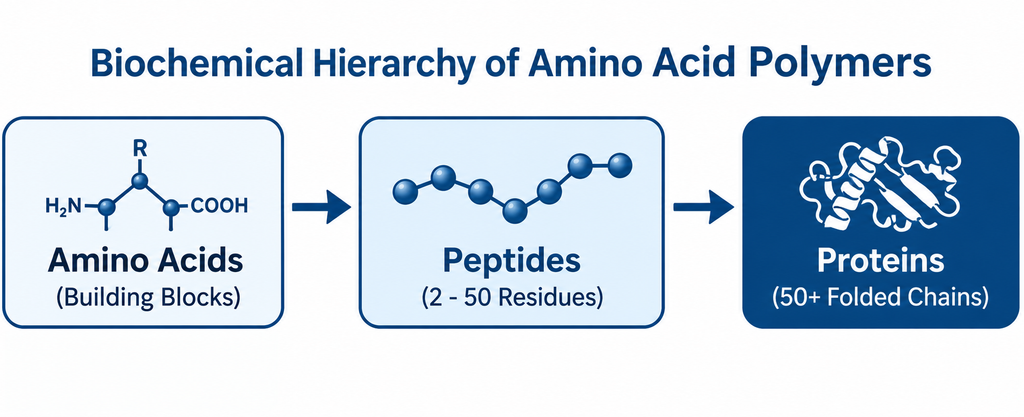
Peptides are relatively short chains of amino acids. Depending on their length, they are classified as:
- Dipeptides (2 amino acids)
- Tripeptides (3 amino acids)
- Oligopeptides (fewer than 10 amino acids)
- Polypeptides (10–50 amino acids)
Peptides typically have a flexible structure and can change their configuration depending on the environment. Learn more about the structure of peptides and their properties.
What are proteins?
Proteins are larger polypeptides, typically consisting of more than 50 amino acids. The distinction between peptides and proteins is arbitrary (40–100 amino acids, usually 50). The main distinguishing feature of proteins is their ability to form a stable tertiary structure, which is necessary for performing biological functions such as oxygen transport (hemoglobin), enzymes, receptors, and signaling molecules.
Amino Acids as the Building Blocks of Peptides and Proteins
Amino acids are organic compounds containing an amino group (NH₂) and a carboxyl group (COOH). Their side chains determine their chemical and physical properties. Of the hundreds of amino acids, only twenty are found in natural proteins and peptides (for example, arginine, lysine, and glutamine). The remaining amino acids are synthesized and used to create new peptides.
Amino acids are linked by peptide bonds (formation of peptides and proteins; structure of the peptide bond). A sequential linkage forms peptides or proteins.
Key Differences Between Peptides and Proteins
| Comparison Criterion | Peptides | Proteins |
|---|---|---|
| Chain Length | Short polymers (usually from 2 to 50 amino acids) | Long polymers (over 50-100 amino acids) |
| Spatial Structure | Linear or simple spatial shape | Complex 3D folding (secondary, tertiary, quaternary) |
| Production Method | Predominantly high-precision chemical synthesis | Complex biological expression in living systems |
| Primary Role | Molecular messengers, signaling functions | Structural scaffold, enzymes, cellular machines |
| Market Examples | Insulin, Semax, BPC-157 | Monoclonal antibodies, Hemoglobin |
Some short proteins are called peptides (insulin), while long peptides are sometimes considered proteins (beta-amyloid). It is important to understand the differences between proteins and peptides in order to classify them correctly.
The Practical Significance of These Differences
Distinguishing between peptides and proteins is important in biotechnology and medicine:
- The methods used to synthesize and purify peptides and proteins differ (methods of production for peptides and proteins).
- Short peptides are typically produced by chemical synthesis and purified by chromatography.
- Proteins are synthesized in living systems (bacteria, yeast, mammalian cells) and purified using complex methods (affinity chromatography, gel filtration).
Understanding the differences between peptides and proteins is important for performing high-quality amino acid reactions and analyzing primary structure. Learn more about the biological roles of proteins and peptides.
The Verdict
Peptides and proteins are two distinct classes of biomolecules with unique functions. The primary structure of peptides and proteins determines their biological activity, and understanding the differences between peptides and proteins is important for biomedical research and drug development. A systematic study of their structure, properties, and synthesis methods ensures high-quality results in both laboratory and clinical practice.
References:
- Kirtikumar Patel. Structural organization of peptides. Principles and Applications. 2023. Link: https://www.sciencedirect.com/science/chapter/edited-volume/abs/pii/B9780323999175000081
- Valentín Iglesias, Oriol Bárcenas, Carlos Pintado‐Grima, Michał Burdukiewicz, Salvador Ventura. Structural information in therapeutic peptides: Emerging applications in biomedicine. FEBS Open Bio. 2024. Link: https://pmc.ncbi.nlm.nih.gov/articles/PMC11788753/
- Braxten D Hornsby, Cheng Hua Lee, Cassidy A Steele, Julius KK Tuekpe, Carol S Lim. Therapeutic peptides and proteins: Status and developments in drug delivery. J Control Release. 2026. Link: https://pmc.ncbi.nlm.nih.gov/articles/PMC13196831/
- Mahira Firudin kizi Amirova. Peptides and Proteins. Azerbaijan Medical University. 2026. Link: DOI:10.13140/RG.2.2.11385.84321
- Malcolm Watford, Guoyao Wu. Protein. Adv Nutr. 2018. Link: https://pubmed.ncbi.nlm.nih.gov/30060014/




Jayatika Bhowick
PhD, Peptide Researcher

Laly Yang
MD, Writing Medical Information

Sachin Nalewade
PhD, Verifies Medical Information