
Peptide synthesis is the process of creating peptides by chemically linking individual amino acid residues. The process is based on the formation of a peptide bond between the carboxyl group (C-terminus) of one amino acid and the amino group (N-terminus) of another.

Modern peptide synthesis methods make it possible to create a wide range of peptides, opening up new horizons for research and medical applications. For more information on the biological synthesis of peptides, see here.
Table of Contents
- Stages of Peptide Synthesis
- Peptide Synthesis Methods
- Purification and Quality Control of Synthetic Peptides
- The Importance of Synthetic Peptides in Science and Medicine
Stages of Peptide Synthesis
Peptide Bond Formation
The main step is the formation of a peptide bond. Unlike peptide synthesis in the body, where proteins are synthesized from the N-terminus to the C-terminus, artificial synthesis typically proceeds from the C-terminus to the N-terminus. This is due to the nature of the chemical reactions and the protection of the amino acid functional groups.
Reactivity Issues and Group Protection
Amino acids have reactive functional groups that can cause side reactions, reducing the purity of the product. To prevent this, protective groups are used:
- N-terminal protective groups (temporary): Boc, Fmoc, are easily removed during synthesis.
- C-terminal protective groups: used primarily in liquid-phase synthesis.
- Side-chain protective groups (permanent): protect the side chains of amino acids and are removed in the final stage using strong acids.
Peptide Synthesis Methods
Solution Phase Synthesis, SPS
The method was originally used in solution and remains relevant for industrial-scale applications; however, it is less efficient and yields lower-purity products than solid-phase synthesis. Learn more about the method here.
| Feature | Solution Phase (SPS) | Solid Phase (SPPS) |
|---|---|---|
| Reaction Medium | Liquid solution | Resin / Polymer support |
| Scalability | Excellent (Industrial scale) | Limited / Medium |
| Purity & Yield | Lower purity / Harder isolation | High purity (Standard approach) |
| Speed | Slow, multi-step isolation | Fast, automated processes |
Solid Phase Peptide Synthesis, SPPS
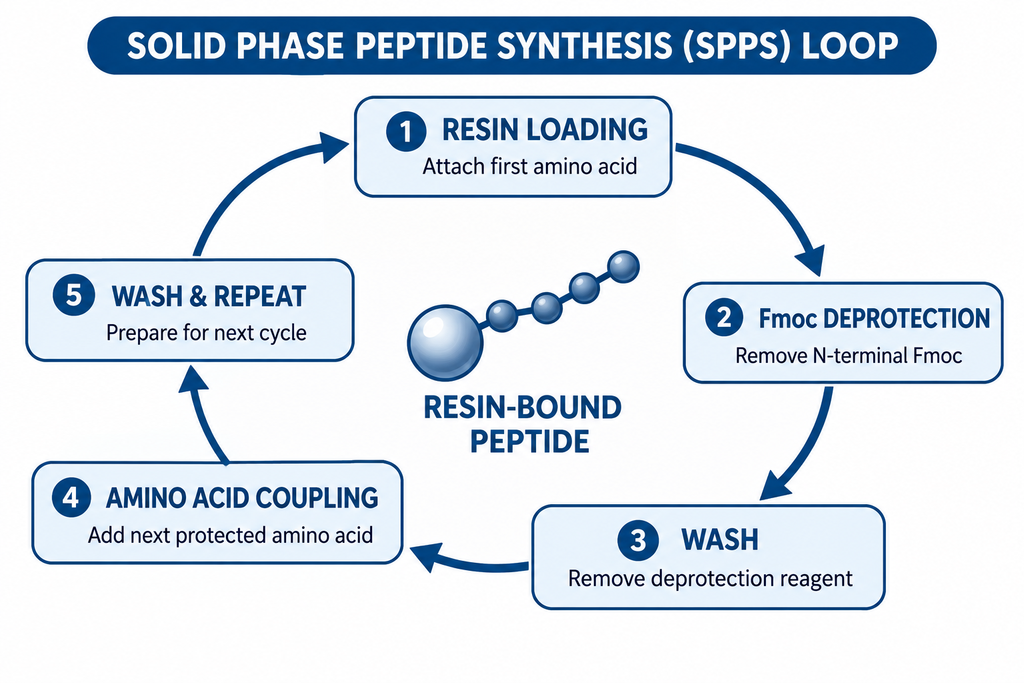
The standard method for modern chemical peptide synthesis (peptide synthesis methods). It is based on the sequential attachment of amino acids to a solid polymer support. The main steps are:
- Attachment of the first amino acid to the carrier polymer.
- Protection of reactive groups.
- Addition of the next amino acid.
- Removing the protection group (de-protection).
- Cleavage of the peptide from the carrier; isolation of the free peptide.
Microwave Solid-Phase Synthesis
It is used to accelerate the synthesis of long peptides, reduce reaction time, and increase product yield. It requires specialized equipment.
Purification and Quality Control of Synthetic Peptides
Even with modern synthesis methods, byproducts remain, especially with long chains. Therefore, peptide purification is essential (chemical synthesis of peptides):
- Reverse-phase chromatography (RPC): separation based on hydrophobic properties, high purity.
- High-Performance Liquid Chromatography (HPLC): high-purity separation, high sensitivity, and separation of trace impurities.
After purification, purity and identity are verified using mass spectrometry and analytical HPLC. Learn more about purification methods here.
The Importance of Synthetic Peptides in Science and Medicine
Synthetic peptides are a key tool in biomedical research. They help uncover new biological mechanisms and develop therapeutic drugs. Dozens of drugs are already in use to treat diabetes, cancer, autoimmune diseases, and infectious diseases. Their value stems from their high specificity, low toxicity, and targeted action on molecular targets.
The Verdict
Peptide synthesis is a dynamic field that bridges chemical technology and biomedical research. Advances in peptide synthesis, purification, and analysis methods make it possible to create complex and effective peptides, opening up vast opportunities for further discoveries in medicine and biology.
References:
- Yuliya V. Karpievitch, Ashoka D. Polpitiya, Gordon A. Anderson, Richard D. Smith, Alan R. Dabney. Liquid Chromatography Mass Spectrometry-Based Proteomics: Biological and Technological Aspects. Ann Appl Stat. 2010. Link: https://pmc.ncbi.nlm.nih.gov/articles/PMC3095207/pdf/nihms293231.pdf
- Kelly da Silva Bezerra. Perspective Chapter: High-Performance Liquid Chromatography Coupled to Mass Spectrometry – The Advance in Chemical Analysis. 2023. Link: https://www.researchgate.net/publication/371018561_Perspective_Chapter_High-Performance_Liquid_Chromatography_Coupled_to_Mass_Spectrometry_-_The_Advance_in_Chemical_Analysis
- Narisa K. Bordeerat, Nadia I. Georgieva, David G. Klapper, Leonard B. Collins, Tyra J. Cross, Christoph H. Borchers, James A. Swenberg, Gunnar Boysen. Accurate quantitation of standard peptides used for quantitative proteomics. Proteomics. 2009. Link: https://pmc.ncbi.nlm.nih.gov/articles/PMC2766299/pdf/nihms146789.pdf
- Dagmara Tymecka, Aleksandra Misicka. Solution Phase Peptide Synthesis: The Case of Biphalin. Methods Mol Biol. 2020. Link: https://pubmed.ncbi.nlm.nih.gov/31879915/
- Mohsen Akbarian, Ali Khani, Sara Eghbalpour, Vladimir N Uversky. Bioactive Peptides: Synthesis, Sources, Applications, and Proposed Mechanisms of Action. Int J Mol Sci. 2022. Link: https://pmc.ncbi.nlm.nih.gov/articles/PMC8836030/
- Cristina Martínez-Villaluenga, Blanca Hernández-Ledesma. Peptides for Health Benefits. Int J Mol Sci. 2022. Link: https://pmc.ncbi.nlm.nih.gov/articles/PMC9223426/




Jayatika Bhowick
PhD, Peptide Researcher

Laly Yang
MD, Writing Medical Information

Sachin Nalewade
PhD, Verifies Medical Information