
The solubility of peptides is one of the key characteristics that directly affects their successful use in laboratory research and scientific experiments.
Low solubility can significantly slow down a researcher’s work, complicate sample preparation, and affect the reproducibility of results.

This article provides a detailed examination of the factors affecting the solubility of peptides and offers practical recommendations for selecting the optimal solvent based on the molecule’s physicochemical properties.
Table of Contents
- Factors Affecting Peptide Solubility
- Preliminary Analysis of Peptide Solubility
- Practical Guidelines for Dissolving Peptides
- Technical Methods for Improving Solubility
Factors Affecting Peptide Solubility
Amino Acid Composition as a Key Parameter
The solubility of a peptide is primarily determined by the amino acids that make up its structure. From a physical chemistry perspective, amino acids are typically classified based on the nature of their side chains.
- essential amino acids (Lys, Arg, His);
- acidic amino acids (Asp, Glu);
- polar, uncharged amino acids (Ser, Thr);
- nonpolar (hydrophobic) amino acids (Ala, Phe, Leu, Val).
Peptides with a high content of hydrophobic residues generally have low solubility in aqueous media. In such cases, organic solvents such as DMSO, DMF, methanol, or isopropanol are preferred.
Preliminary Analysis of Peptide Solubility
Calculating the Total Charge of a Peptide
Before selecting a solvent, it is recommended to perform a preliminary calculation of the molecule’s total charge. This approach allows you to predict the peptide’s behavior in various media in advance.
- Each Asp and Glu residue, as well as the C-terminus, is assigned a charge of −1.
- Each Lys and Arg residue, as well as the N-terminus, is assigned a charge of +1.
- The His residue is assigned a charge of +1 at a pH of approximately 6.
- Summing the values gives the total charge of the peptide.
The resulting value makes it possible to determine whether the peptide will dissolve better under acidic, basic, or neutral conditions (solubility analysis).
Practical Guidelines for Dissolving Peptides
Basic Approach
It is recommended to begin dissolving any peptide in sterile water. Short peptides (fewer than 5 amino acid residues) are, in most cases, easily soluble in water.
Choosing a Solvent Based on Charge
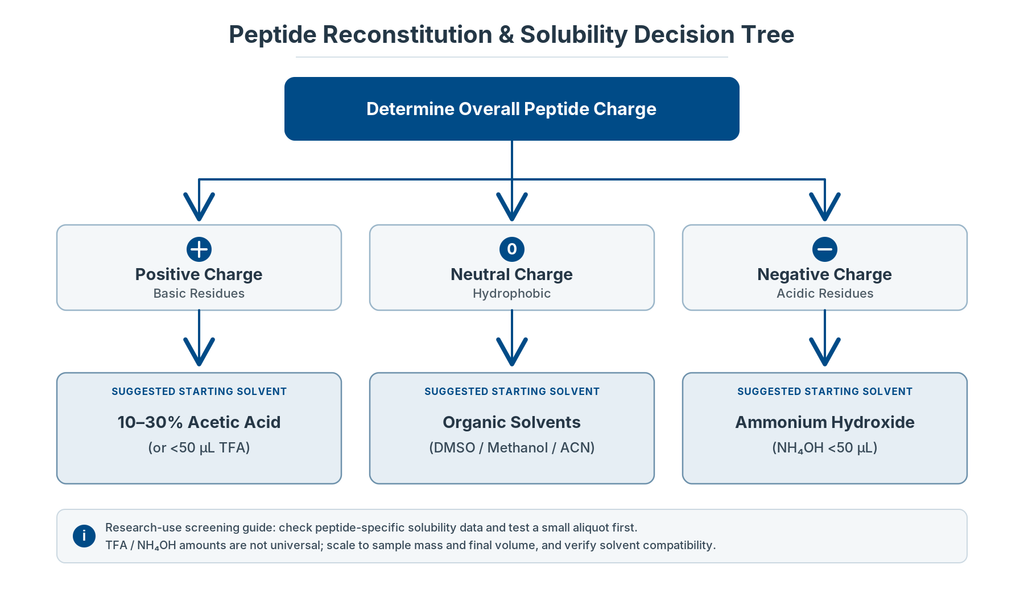
| Peptide Property / Charge | Recommended Solvent | Critical Notes & Limitations |
|---|---|---|
| Positive Charge | 10–30% Acetic acid | Adding TFA < 50 μL is acceptable |
| Negative Charge | NH₄OH < 50 μL | Do not use if Cys (Cysteine) is present |
| Neutral | DMSO, Methanol, Acetonitrile | Consider the risk of oxidation |
| Prone to Aggregation | 6M Guanidine-HCl or 8M Urea | Used for temporary dissolution only |
It should be noted that peptides containing cysteine, methionine, or tryptophan are susceptible to oxidation in the presence of DMSO (peptide oxidation).
Technical Methods for Improving Solubility
In some cases, it is permissible to use auxiliary methods that accelerate the dissolution process without altering the peptide’s structure.
- briefly heating the solution to 40 °C;
- ultrasonic sonication of limited duration;
- Slow stirring without excessive foaming.
These methods cannot fundamentally change low solubility, but they can make it easier to work with difficult-to-dissolve peptides (dissolution methods).
Storage of Dissolved Peptides
Once a solution of the desired concentration has been prepared, it is recommended to immediately divide the peptide into aliquots. Store at −20 °C or below.
Special attention should be paid to peptides containing Cys, Met, and Trp, as they are susceptible to oxidation. For such compounds, storage in an oxygen-free environment is preferred.
The Verdict
The solubility of peptides is determined by their amino acid composition, charge, and structural characteristics. Careful selection of a solvent and adherence to practical guidelines help maintain peptide stability and ensure the reproducibility of experiments.
The systematic application of the approaches described significantly improves the quality of laboratory work and the reliability of the scientific data obtained.
References:
- Cristina Martínez-Villaluenga, Blanca Hernández-Ledesma. Peptides for Health Benefits. Int J Mol Sci. 2022. Link: https://pmc.ncbi.nlm.nih.gov/articles/PMC9223426/
- Riccardo Torosantucci, Christian Schöneich, Wim Jiskoot. Oxidation of therapeutic proteins and peptides: structural and biological consequences. Pharm Res. 2014. Link: https://pubmed.ncbi.nlm.nih.gov/24065593/
- Marc Oeller, Ryan J. D. Kang, Hannah L. Bolt, Ana L. Gomes dos Santos, Annika Langborg Weinmann, Antonios Nikitidis, Pavol Zlatoidsky, Wu Su, Werngard Czechtizky, Leonardo De Maria, Pietro Sormanni, Michele Vendruscolo. Sequence-based prediction of the intrinsic solubility of peptides containing non-natural amino acids. 2023. Link: https://www.nature.com/articles/s41467-023-42940-w
- Oliwia Polańska, Natalia Szulc, Rafał Stottko, Mateusz Olek, Julita Nadwodna, Marlena Gąsior-Głogowska, Monika Szefczyk. Challenges in Peptide Solubilization – Amyloids Case Study. Chem Rec. 2024. Link: https://pubmed.ncbi.nlm.nih.gov/39023378/




Jayatika Bhowick
PhD, Peptide Researcher

Laly Yang
MD, Writing Medical Information

Sachin Nalewade
PhD, Verifies Medical Information